How to Turn a PubMed Paper Into Slides With AI

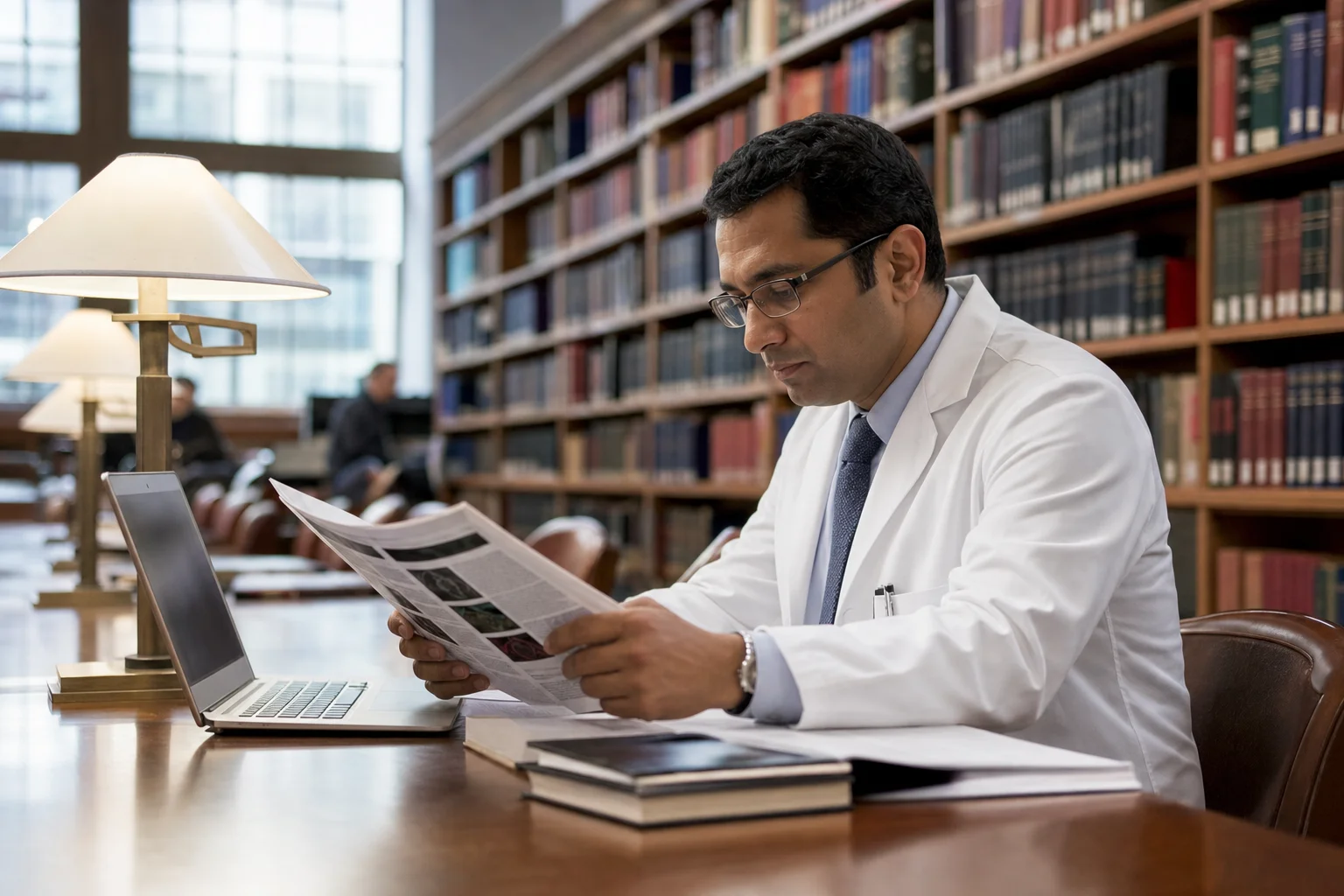
PubMed contained 41,020,119 records when we queried the National Library of Medicine's API this month. Somewhere in that number is the handful of papers you actually need to present next week, and the gap between finding them and standing in front of a room talking about them is where a surprising amount of academic time disappears.
Montreal's teaching hospitals run on this cycle constantly. Rounds, journal clubs, case conferences, research days. The paper gets read, and then it has to become slides.
Start from the record, not from a copy-paste
The single most useful thing to understand about AI presentation tools in a clinical or research setting is that they behave very differently depending on what you feed them.
Paste text into a general-purpose tool and it sees an undifferentiated block of prose. It has no idea which paragraph is the methods section and which is the discussion, so it treats a limitation and a finding as equally weighted sentences. The output looks plausible and is subtly wrong in emphasis.
Give a tool a structured source instead, a PubMed identifier or a DOI, and it has the article's actual architecture available: title, abstract, authors, journal, publication date, MeSH terms, and the section boundaries. Tools built for academic work, such as ChatSlide's AI presentation maker for research papers, accept those identifiers directly rather than requiring you to paste. The practical difference is that citations come out formatted instead of mangled, and the section structure survives.
It is a small distinction that determines most of the output quality.
What survives the conversion, and what does not
Survives well: trial characteristics, sample sizes, outcome measures, dosing tables, author and journal metadata, reference formatting. Anything structured and factual moves across accurately.
Survives badly: emphasis. The generated deck will mirror the paper's own weighting, and papers are written to persuade a reviewer, not to brief a colleague in ten minutes. Discussion sections in particular are optimistic by convention, and an AI reading one will report that optimism as finding.
Does not survive at all: your figures. Every one of these tools will offer a generated placeholder graphic where your data belongs. In a clinical presentation this is worse than an empty slide, because it looks like evidence and is not. Replace them before you present, without exception.
The order problem
A paper and a talk want opposite structures, and this is the edit no tool makes for you.
A journal article front-loads context. Background, then methods, then results, because a reader has committed to sitting with it and can reread anything.
A presentation has to front-load the finding, because your audience cannot rewind and will decide within ninety seconds whether to keep listening. If your headline result is not visible by the third slide, you have built the paper again rather than a talk.
So the reliable edit on any AI-generated draft is: cut the background to a single slide, move the primary outcome forward, and let the methods appear afterwards as justification rather than as preamble.
A method that holds up
- Feed in the PubMed record or DOI rather than pasted text.
- Keep the extracted characteristics and citations. That is the real time saving.
- Delete the generated background slides down to one.
- Move the primary finding to slide three.
- Swap every placeholder graphic for your actual figures at full resolution.
- Add absolute numbers anywhere the paper gave you only relative ones.
The verdict
AI has made the transcription half of academic presentation work essentially free, while leaving the judgment half exactly as expensive as it always was — and the researchers who benefit are the ones who spend the reclaimed hour on emphasis and appraisal rather than banking it.
The tools are genuinely good now at the part that never required a clinician. They remain incapable of the part that does. That is not a criticism of them so much as a description of where the work moved.