Can a Document Parser Teach Itself? Inside OXR's RSI Loop

Most progress in document parsing has come from a familiar recipe: collect more labeled pages, train a bigger model, repeat. Labeling is the expensive part. Someone has to mark every table cell, every formula and every reading-order decision on thousands of pages, and the pages that matter most are the strange ones, where labels are hardest to produce.
SoMarkAI, a document-parsing company headquartered in Shanghai, has published a model that tries a different route. OXR (Optical Everything Recognition) is a 1.3-billion-parameter parser whose code and weights went public on October 20, 2026. Its post-training uses what the team calls a recursive self-improvement (RSI) loop: a system that finds the samples the model misreads or is uncertain about and generates training data aimed at them, and the training data it generates needs no human annotation. To the team's knowledge, OXR is the first document parser trained this way.

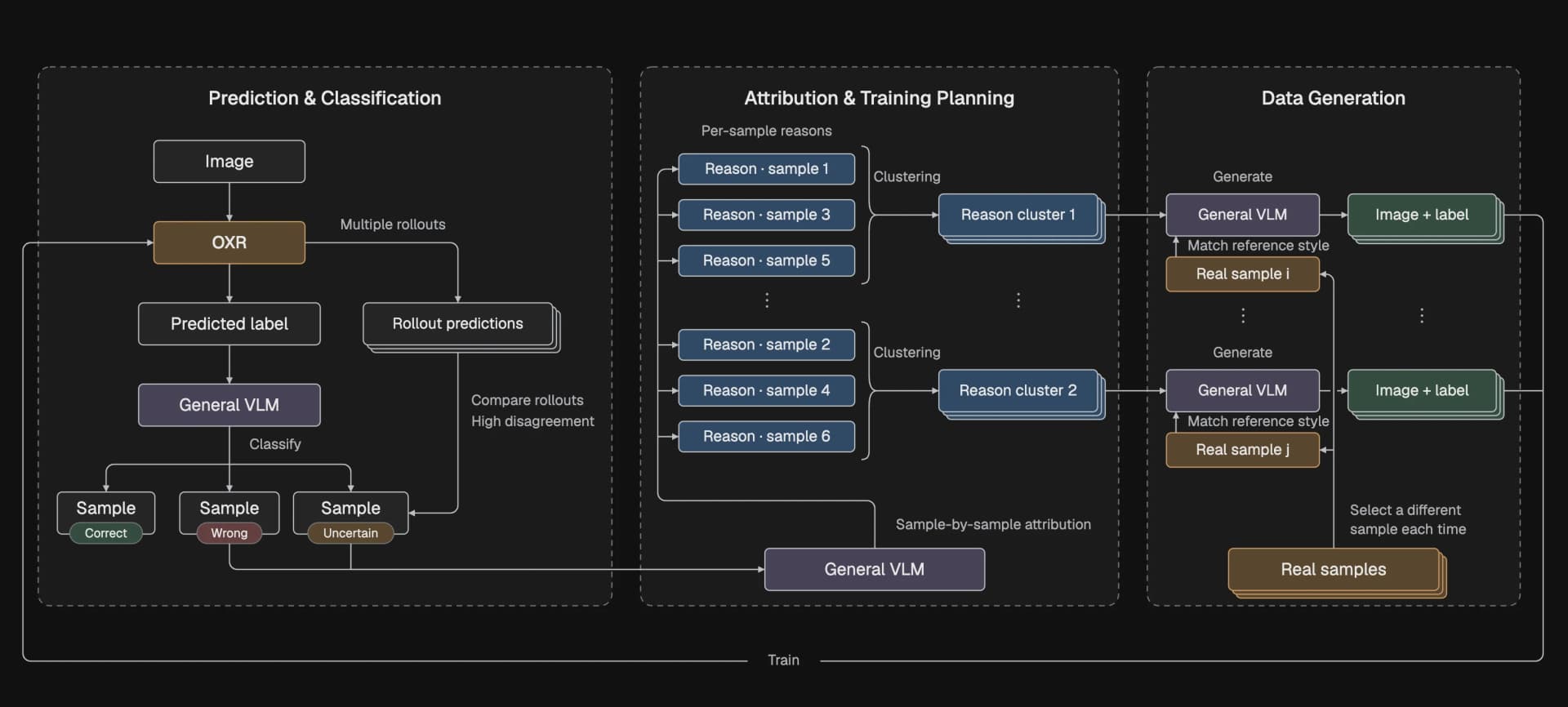
OXR's recursive self-improvement loop. Source: SoMarkAI.
What the loop does
The loop, as SoMarkAI describes it in the OXR repository and in a technical blog post, runs in three stages, repeated round after round.
First, prediction and classification. OXR parses unlabeled documents, and a stronger general-purpose vision-language model reviews each result against the original page and a set of judging criteria. It sorts every sample as correct, wrong or uncertain. A second signal comes from OXR itself: the same sample is parsed several times, and where the repeated predictions disagree, the sample is treated as uncertain. Keeping an uncertain class means the critic's hesitation is not hidden inside a confident-looking label.
Second, attribution and training planning. For each wrong or uncertain sample, the vision-language model writes down possible reasons, and one sample can have several; for an uncertain sample it looks at what makes the prediction unstable rather than assuming it is wrong. The reasons are encoded and clustered, so similar reasons from different documents land in one reason cluster. A capitalization slip in a research report and unstable capitalization in a technical manual, for example, fall into the same cluster, and the clusters become the plan for the next training round.
Third, data generation. The vision-language model writes code that draws and renders new documents aimed at each reason cluster, borrowing layout and visual style from real samples so the data does not collapse into one template. Only data that passes rule-based validation and filtering goes into training, and that generated data needs no human annotation.
Then the loop repeats. The retrained OXR parses real documents again, and its new results start the next round. SoMarkAI tracks progress with a repair rate: the share of the previous round's wrong samples that the critic judges correct after retraining.
The README states the goal plainly: for a task where ground-truth answers exist, the team wanted an engineering system that helps the core model improve itself, targeting the samples it gets wrong or is uncertain about.
Where the idea comes from
None of the individual ingredients is new, which is part of what makes the combination worth examining.
Using a model's own predictions to train it has a long history under names such as self-training and pseudo-labeling. Google's Noisy Student work showed in 2020 that a model trained on its own labels for unlabeled images, with noise added, could beat its teacher on ImageNet. The weakness of naive self-training is also well known: a model that learns from its own mistakes can reinforce them.
Using disagreement between repeated outputs as a confidence signal also has precedent. The self-consistency method for language models samples several reasoning paths and treats agreement among them as evidence of a reliable answer. OXR's loop applies the reverse logic: disagreement marks the samples worth training on.
What the RSI loop adds is the routing. Instead of training on everything the model labels confidently, it concentrates effort on reason clusters built from the samples the model misreads or cannot settle on, and it puts an external critic and rule-based checks between the model and its own training data. That is the step that addresses the classic risk of self-training.
Why document parsing suits this approach
Document parsing has a property many AI tasks lack: answers can often be checked. A table either has the right number of rows and columns or it does not. A LaTeX formula either compiles or it fails. A chemical structure written in SMILES notation can be validated by software. Reading order has a correct answer for most pages.
That makes rule-based verification realistic. In open-ended text generation, an automatic check of quality is hard to write. In parsing, many checks are mechanical, and the RSI loop leans on exactly that.
OXR's architecture fits the method too. Layout analysis runs as a separate, replaceable model, while OXR predicts text recognition and reading order in one pass. With fewer stages inside the model being trained, failures are easier to attribute, and a targeted training round can focus on recognition and ordering.
What the results show
SoMarkAI credits OXR's accuracy and speed to the architecture and the RSI loop working together. In SoMarkAI's comparison against published scores, OXR ranks first on three public benchmarks: 87.84 on olmOCR-Bench, 97.18 on OmniDocBench and 87.76 on DocParsingBench. On DocParsingBench it leads in the overall, text, formula and table categories among 17 compared systems.
The company is careful about what those numbers are. Peer-model scores come from published papers, model cards and official leaderboards, with the snapshot dated October 5, 2026, and the rankings apply to the models displayed. OXR's DocParsingBench score is averaged over three evaluation rounds. The evaluation setup is published in the repository's benchmark document, so others can rerun the OXR side.
Speed was measured directly. On one NVIDIA RTX PRO 6000 Blackwell GPU, against the same 100 OmniDocBench pages, OXR's end-to-end pipeline took 100.972 seconds, the fastest of 21 models tested.
Open questions for the technical report
A technical report is listed as coming soon, and several questions will interest researchers when it arrives.
How many RSI rounds were run, and how much did each round move the benchmarks? The repair rate shows whether a round fixed its own wrong samples; a per-round curve of benchmark scores would show whether the loop keeps finding useful failures or levels off.
How is the critic kept honest? A vision-language model reviewing outputs has its own blind spots. If the critic and the parser share a weakness, the loop could miss it. The uncertain class, the disagreement signal from repeated predictions and the rule-based checks are the team's answers; how much each one filters would be useful to know.
How well does the method transfer? Because layout analysis is pluggable, a company could pair OXR with its own layout model for invoices or lab reports. Whether the RSI loop can be rerun on a customer's private documents to adapt the model is a natural next question.
Availability
OXR's weights are on Hugging Face and ModelScope, and a free hosted API with no signup is available for testing at free-oxr.somark.ai. The model is released under a custom license based on Apache 2.0. Commercial use is free for organizations below USD 2 million in total funding or annual revenue; above either threshold a commercial license from SoMarkAI is required, and offering a competing hosted API is not permitted.
For researchers, the practical point is that the model is available to examine now, ahead of the paper. The weights can be downloaded, the benchmark protocol can be rerun, and the claims about where the model is strong and where it is still unstable can be tested against real documents.