Westburne Marks a Century in Canada With a 300-Guest Event in Laval

The company that filled a Laval parking lot with food trucks, demo stations and a robot dog this summer started life a century ago in Montréal, and not in electricity at all.
Westburne, today one of the country's larger electrical distributors, was incorporated in 1926 as the Westburne Oil Company Limited, a Montréal-registered venture backed by Calgary businessmen chasing the gas boom in Alberta's Turner Valley. The pivot came slowly. A plumbing and heating wholesaler in Québec City, Saillant Inc., became its first distribution acquisition in 1952. Electrical supply followed in 1967, refrigeration and ventilation in 1979, and by 2000 the company had sold off everything that was not electrical. Rexel acquired it the following year.
That hundred-year arc was the occasion for the Laval gathering, which drew roughly 300 customers, suppliers and staff for a day that functioned as equal parts reunion and trade show.
Archives on one side, automation on the other
The layout did most of the storytelling. Guests moved from archival stations tracing the company's century in Canada straight into hands-on demonstrations of automation-ready equipment, including a robot dog that, by the organizers' own account, stole the show.
The juxtaposition was deliberate. Electrical distribution has spent the past decade absorbing a wave of connected hardware, and the branches that once sold conduit and breakers now field questions about controls, sensors and building automation. Putting the filing cabinet next to the robot made the point without a slide deck.
Westburne reported longer dwell times and heavier interaction at every station than in previous years, which it attributed to the equipment on display rather than the hospitality. The hospitality was not absent: an Eaton tent, a food truck line, games and themed stations ran alongside the demos all day.
The conversations were the product
Events like this are easy to dismiss as customer appreciation with a catering budget. What the organizers noticed instead was the substance of the talk. From the Eaton tent to the food truck queue, customers and suppliers were discussing products, industry trends and specific problems rather than simply catching up, turning a celebration into something closer to a working day.
That matters more than it sounds for a distributor. Westburne sits between manufacturers and the contractors, plants and institutions that install their equipment, and a good deal of its value is knowing what is coming and who needs it. A parking lot where a supplier's business development manager and a contractor end up in the same food line is, in that sense, infrastructure.
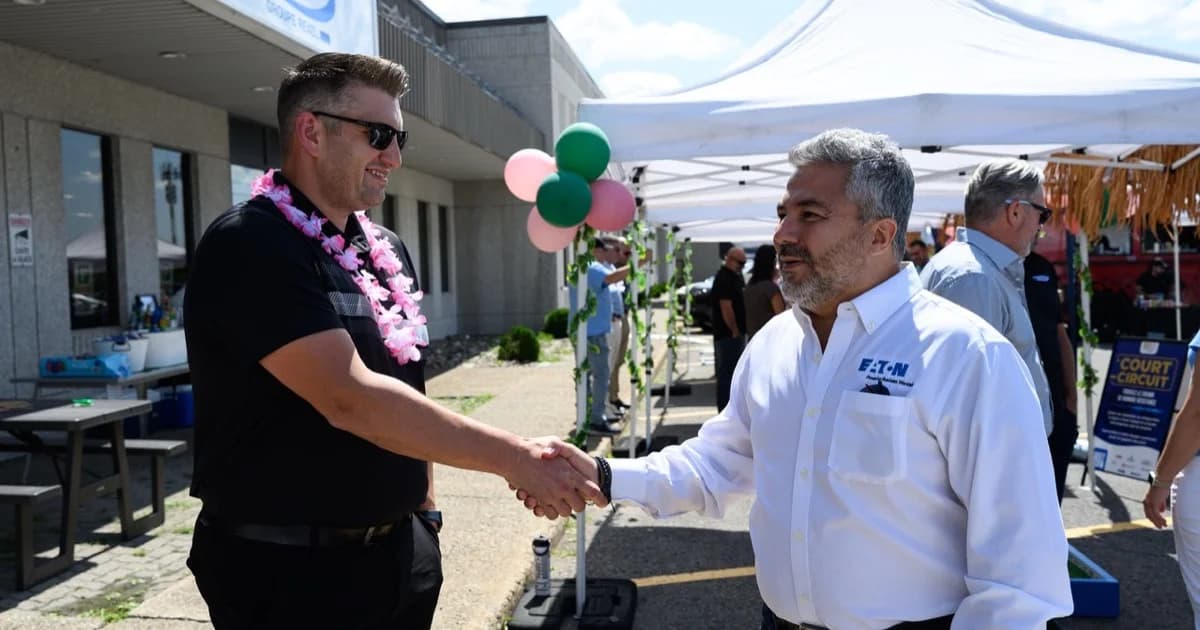
Pictured above are Nicolas Pinard, general manager for Québec at Westburne, left, and Carlos Cano, electrical channel business development manager at Eaton.
From Turner Valley to switchgear
The company's origin story reads like a history of Canadian industry in miniature. Western Canada's first producing oil well had been drilled on Cameron Creek in 1902, in what is now Waterton Lakes National Park, and the 1923 discovery of the Wainwright field had rekindled hopes that large reservoirs lay beneath Alberta. It was into that speculative boom that Westburne Oil was born, a Montréal charter chasing Alberta gas.
What kept the name alive for a century was a willingness to abandon the business it was founded on. The distribution acquisitions that began with Saillant in 1952 gradually became the company, and the resource plays that had justified the original charter were sold off. By the time Rexel, the French distribution group, bought Westburne in 2001, the transformation was total: an oil company that had become a pure electrical distributor, with the drilling era surviving only in the archives that guests browsed in Laval.
Under Rexel Canada, Westburne now operates alongside Nedco, another distribution banner that also traces its roots back more than a hundred years — making the parent company home to two Canadian centenarians at once. Westburne itself has grown to more than 100 branches and over 1,000 employees nationwide, and its equipment sits behind projects as visible as Toronto's Rogers Centre and Montréal's Hydro-Québec Jean Lesage station.
A birthday spent on the labour problem
Westburne is not marking the anniversary with nostalgia alone. Through 2026 the company is putting $60,000 into twelve skilled-trades scholarships across Québec, Alberta and Ontario, with $15,000 directed to each participating school.
The timing is not accidental. The trades that install what Westburne sells are short of people, and the shortage is measurable: Statistics Canada reported that 13.3 per cent of Canadian job vacancies in the fourth quarter of 2025 required a trade certificate or diploma, just under the record 13.9 per cent set a year earlier. Every electrician who does not exist is a project that slips, and for a distributor, a delayed project is delayed revenue. Funding trade schools is about as close to enlightened self-interest as corporate philanthropy gets.
The company frames the scholarships as part of a larger repositioning, from distributor to what it calls a solutions provider: a business that supplies not just the material for a project but the technical guidance to specify and commission it. That repositioning only works if there are tradespeople on the other end of the counter to guide, which is why the anniversary money is going to schools rather than to a bigger party.
The centennial has a personal-effort component as well. Westburne president Anshul Mathur spent August 22 to 24 climbing Mount Rainier to raise money for Raising the Roof, a national charity focused on long-term homelessness prevention, with the company matching eligible donations up to $15,000.
"The best way to honour a century of building Canada is to help build what comes next," Mathur said of the anniversary program. "Our first 100 years were built on trust, relationships and service, and those same values will carry us into the next 100."
One stop on a national lap
The Laval gathering was not a one-off but the Québec leg of a cross-country centennial program. The tour opened on June 18 in Brandon, Manitoba, where Westburne folded the anniversary into its annual Midwest Business Community Event — a fixture that has run for more than fifteen years and this time drew over 220 attendees from more than 60 partner businesses and suppliers, alongside a special installation tracing the company's hundred years in Canada.
"This year's strong turnout reflects the strength of the relationships we've built across Western Manitoba and the Midwest over the past six decades," said Leigh Budd, Westburne's general manager for the Midwest region, of the Brandon kickoff.
After Laval, the program moves west and east at once, with stops planned in Edmonton and Mississauga in September. Threaded through it all is a baton relay travelling branch to branch under the banner of a hundred years of showing up and solving problems — complete with an internal leaderboard that has the company's divisions competing for points as the torch works its way coast to coast. The company has also assembled its history on a dedicated centennial site, westburne100years.ca, and has begun formally archiving the documents, photographs and objects that record its evolution.
The pattern across the stops is consistent: each event leans on a long-standing local relationship — an annual trade gathering in Brandon, a fifty-year provincial operation in Laval — rather than manufacturing an occasion from scratch. For a company whose product is, in large part, the durability of its relationships, the birthday tour doubles as a proof of concept.
A Québec footprint
Westburne dates its current Québec operations to 1975 and employs 429 people across the province, a base that has outlasted several changes of ownership and one complete change of industry.
The next hundred years are electric
If the first century was a slow migration from hydrocarbons to electrons, the next one is shaping up as a bet on how much more work electrons will be asked to do. Westburne says it is expanding its technical capabilities in industrial automation, electric-vehicle infrastructure, energy-efficient technologies, transit and connected AI network solutions — the categories on display beside the robot dog in Laval.
The logic is straightforward. Electrification is pushing new load onto buildings and grids: vehicle chargers in parking garages, heat pumps replacing gas furnaces, data centres and AI hardware multiplying demand. Each of those is, at street level, an electrical project that needs switchgear, cable, controls and someone who knows which of them to buy. The distributor's traditional job — having the part on the shelf — is acquiring a consulting layer, and Westburne's manufacturer partners at the Laval event, from Eaton and ABB to Rockwell Automation and nVent, are pushing the same direction with connected, automation-ready product lines.
That is the context that made a robot dog a sensible birthday guest. It was not there as a mascot; it was there as a preview of the kind of inventory a hundred-year-old distributor expects to be explaining to contractors in year 101.
For a firm that began by drilling for gas in Alberta and now sells the switchgear behind automated buildings, the through line is less about electricity than about distribution itself: being the company that has the part, knows the application, and is still there in a hundred years to be asked.
Photo courtesy of Westburne.